| |||||
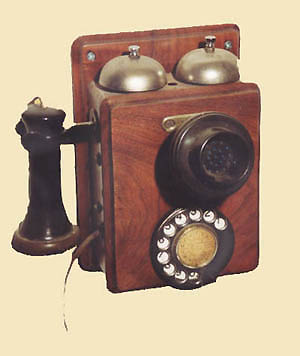
Type 37 Wallset In slightly differing styles it was made by Siemens, Peel Conner, ATM, Ericssons, and Phoenix in Britain. Some were also made up in local timber by the PMG Workshops. The case dimensions are similar to those of the bellset No. 1.
Early auto models were fitted with a black oxidised fingerplate on the No. 8 and No. 10 dials (these dials had a smaller centre label holder). The black plate was replaced by a stainless steel "StayBrite" fingerplate about 1930, with a larger diameter label holder.
Model 237 incorporated the new bakelite handset on a modified switchhook. Older phones were completely stripped, cleaned and refurbished, as they had to compete with the newer bakelite models. Metalwork was replated where necessary, and the newer No. 10 dial was added. A new black rayon anti-twist cord was fitted, which was later replaced with the black plastic-covered "curly cord". The PMG had a large stock of earlier Type 37s and bellboxes recovered from redundant candlestick phones and this was an economic way to use them. The refinished phones were very attractive in their woodgrained maple, oak and walnut timbers. The 37 series remained the standard auto wall phone until the early 1950s. At this point bakelite mouldings took over.
| |||||

 This little box wall phone was based on a British Post Office pattern, their
Tele 21. With the invention of the Solid Back transmitter by White of Western
Electric, a smaller box set could now be used. In Australia it was known as
the Type 37 CBW (CB version) or Type 37 AW (automatic version). The Solid
Back gave way to the bakelite Inset capsule transmitter, and the model number
was upgraded to Type 137. In a final modification a handset was added on a
modified switchhook and the model again redesignated 237.
This little box wall phone was based on a British Post Office pattern, their
Tele 21. With the invention of the Solid Back transmitter by White of Western
Electric, a smaller box set could now be used. In Australia it was known as
the Type 37 CBW (CB version) or Type 37 AW (automatic version). The Solid
Back gave way to the bakelite Inset capsule transmitter, and the model number
was upgraded to Type 137. In a final modification a handset was added on a
modified switchhook and the model again redesignated 237.