Western Electric Telephones - United StatesSee also Bell Telephone Manufacturing of Antwerp for European phones.. Western Electric
used a complicated numbering system based on the model, ringer, whether it was
for CB or auto use, etc. I think these models are numbered correctly, but I would
appreciate further details as collectors will often find numbers on their phones
that don't quite fit the basic number scheme. There may also be other variations not shown here, but I think most of the range is represented. 
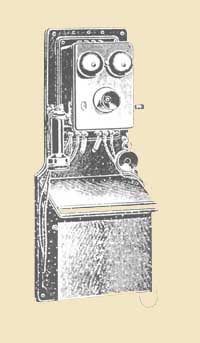 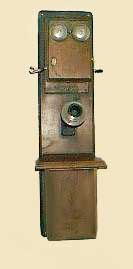 Left:
3-Box Blake, the first mass production telephone by WE, about 1882. The red bar
on the receiver marks it as an export model. Centre: With improvements to
the transmitter it was possible to mount it to the front of the top box. Model
5720 with Hunnings transmitter. Right: Intermediate model 250 with White
solid back transmitter on gooseneck arm. 

 Left:
1897 candlestick, with outside mechanism. Centre: No. 10 Candlestick,1899 Right:
No. 20B candlestick, 1904, with exposed wiring between the tube and the back of
the transmitter. The No. 20AL put the wiring inside the tube and fed it
to the transmitter through the swivel mount. 1905. The No. 40AL was made
of steel instead of brass and was finished in a "Bower Barff" process
that involved oxidising the steel with steam and oil to produce a hard chemical
finish.  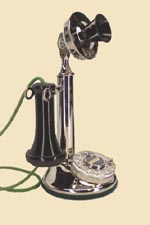
Left: No. 50AL dial candlestick, 1919. The tube was shifted to the rear of the base
to make room for the dial. They were made of brass, generally finished in a black japan paint. Right: Alternate nickel finish. In
about 1938 the phones were upgraded by the addition of a new bakelite mouthpiece.
Models so upgraded had a "1" added to their model numbers.   
A
range of "fiddleback" phones Left: Model 301 magneto wall phone,
about 1895. Centre: 1900 model No 85 issued in both CB and magneto. Right:
Shortened version issued in CB. This version was used by the British and Australian
Post Offices.   
Model
317 magneto wall phone introduced in 1907. It stayed in service for nearly thirty
years, gradually being remodelled due to technical improvements and the need for
higher production. Left: First model with Cathedral Top and Picture Frame
Front. Centre: In 1909 the cathedral Top was discontinued. Right: Late model
with plain case. From about 1911. A later model from 1917 had the metalwork
painted black and the transmitter fitted to a shorter mount. The case was slightly
smaller and the writing slope mounted at a steeper angle. A final Model
416 isued from 1938 had the new bakelite bulldog mouthpiece fitted, with an anti-sidetone
circuit.  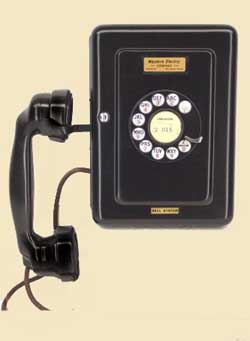
Left:
Small wooden CB wall set No 293 from 1913. Right: Later steel equivalent
from 1930s, based on the No 534 ringer box. An earlier model No 653 had the dial
moved to the top of the case and a bulldog transmitter mounted at the bottom.  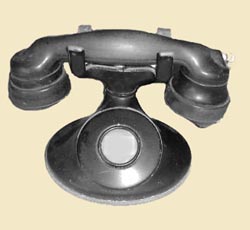 
Left:
Model AA! , an interim phone using a cast aluminium cradle based on the cast brass
base of the candlestick. It was a temporary measure until an anti-sidetone circuit
could be completed, but it gave a chance to test the new handset in service. From
possibly 1925 to 1927. Centre and Right: Model 102 with a modified cradle
and round base. CB and auto versions are shown. Late 1927 to 1930. In 1930
the round base was replaced with an oval one, and the phone was given the model
number 202. With upgrades tot he transmitter and circuitry, this model remained
the standard for the rest of the life of the type.1930 to 1937. 
From
1928 the opportunity was taken to use the new handset in a compact phone called
a Spacesaver. It was designed to be wall mounted or fastened to the side of a
desk.  
Left:
No. 302, the first of the new styles, with a cast metal housing. Designed by Henry
Dreyfuss and put into production in 1937. Later versions used a thermoplastic
case instead of metal, reducing the weight significantly. An "empty"
version without ringer or coil was also made, that could be used as a maintenance
replacement for candlestick phones. No. 354 was a wall version, with very squared-off
lines and the handset suspended down the front of the phone covering the dial.
The phones were in black only, although some were later painted in other colours
in the late 1940s. This was not successful. Right: No. 500, introduced in
1949 and using thermoplastics and updated electronics. Again it was designed by
Henry Dreyfuss Associates, and again it was in black only. It was introduced in
colours in 1954 as Western Electric and Bell tried to react more to public preferences.
A new No. 554 wall phone was also introduced in 1956, similar in style to the
354 but slightly shorter. 
Left:
In another response to public demand, Western Electric released the Princess phone
in 1959. It came in many colours, was light, popular and cheap, and started the
trend towards having more than one phone in the house. Over the years it was upgraded
to touchtone, and many imitations were built by other companies. 
In
1964 transistor technology had progressed to the point that it could be used in
the first TouchTone telephone. It was an instant success.  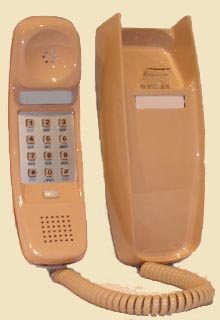
The
Trimline was introduced in 1965. It was also a very popular model, and was widely
copied by other companies. It was later upgraded to pushbutton, and a Portuguese-built
version was sold in Australia by Telecom as the Gondola. Later versions of the
style are still on sale today.  To Western Electric History
 If you have reached this page through a Search Engine, click here to go to this website's Home Page. If you have reached this page through a Search Engine, click here to go to this website's Home Page.
| 